U.S.-Iran Missile Exchanges Resume, Raising Fresh Fears of a Wider Regional War
Background
The latest exchanges mark a widening confrontation between the United States and Iran, with military operations reported inside Iran and retaliatory claims involving U.S. facilities in Bahrain and Kuwait. The crisis has also affected the Strait of Hormuz, a major commercial shipping route, after Iran was reported to have attacked three commercial vessels and the United States responded with strikes on Iranian targets.
Bahrain and Kuwait have become directly exposed to the conflict because they host U.S. military sites. Both countries reported air-raid sirens, while Kuwait said its air defences engaged rocket and drone attacks. Against that backdrop, President Donald Trump has warned that the United States could carry out further action, including a possible move against Kharg Island, while also saying a full-scale war was unlikely and that negotiations might continue.
A new round of strikes expands the confrontation
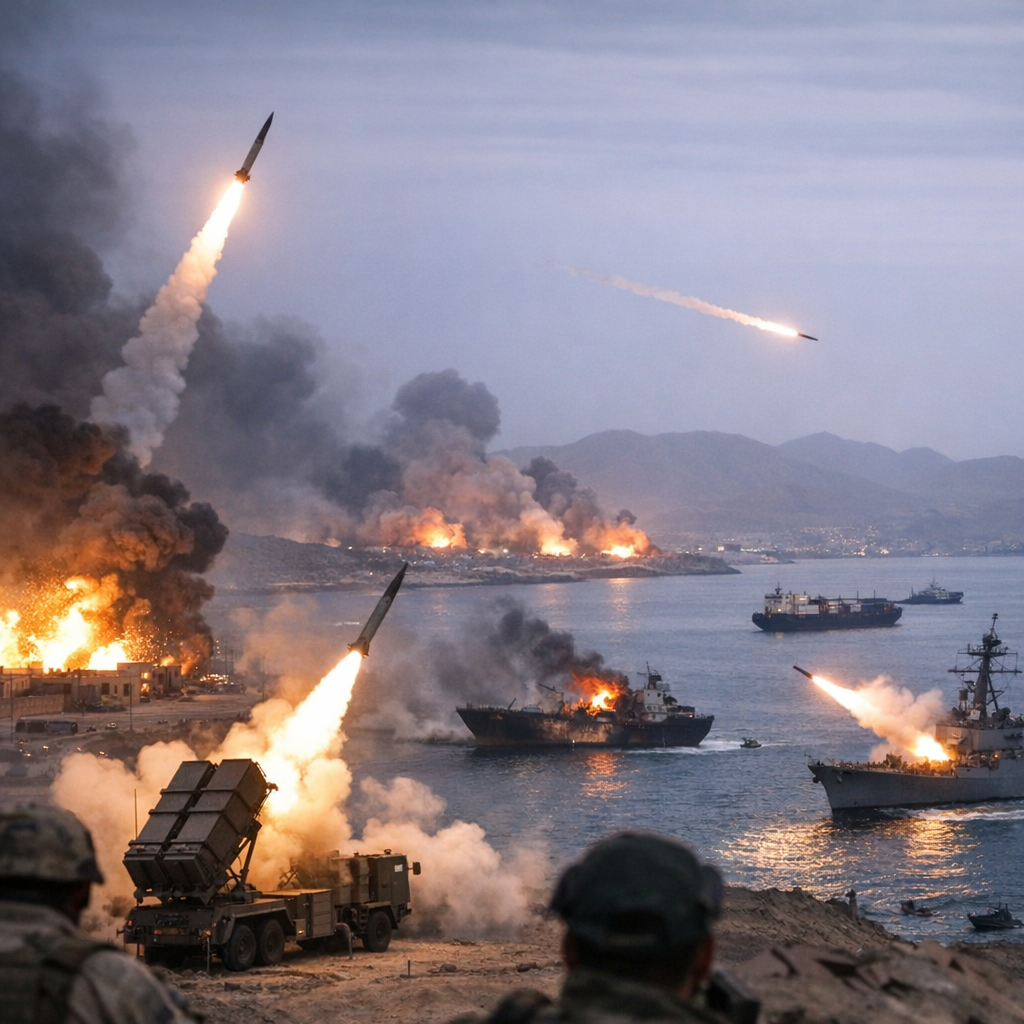
The United States and Iran have exchanged new military blows in a rapidly escalating confrontation that has placed key Gulf states and one of the world’s most important shipping routes at the centre of the crisis. The Guardian reported that the United States struck 80 targets after Iran attacked three commercial vessels travelling through the Strait of Hormuz.
The military response was followed by an additional U.S. strike round, according to Al Jazeera’s account of a statement from US Central Command. CENTCOM said 90 Iranian military targets were hit in that later operation, signalling a broad campaign directed at a range of Iranian military infrastructure.
The reported sequence of attacks has intensified concern that the conflict could move beyond direct U.S.-Iran exchanges and more deeply involve countries hosting American facilities in the Gulf. It has also put commercial transit through the Strait of Hormuz under renewed pressure after the reported attacks on the three vessels.
U.S. operations reportedly targeted military infrastructure
CENTCOM said the additional U.S. strike round hit air-defence systems, coastal surveillance assets, missile and drone storage locations, naval capabilities and logistics facilities. Al Jazeera reported that the strikes reached locations including Iranshahr, Bandar Abbas, Konarak, Chabahar, Bushehr and Aq Qala.
Iranian state media reported that one firefighter was killed at Iranshahr airport. Iran also said eight army and navy personnel had been killed, though the provided reports do not specify whether those deaths were connected to the same locations or strikes.
Iran reports attacks on U.S. facilities in Bahrain and Kuwait
Iran said it targeted 85 U.S. military facilities in Bahrain and Kuwait after reporting the deaths of eight army and navy personnel. The claim marked a major expansion in the stated scope of Iranian retaliation, extending the confrontation to two Gulf states that host U.S. military sites.
Air-raid sirens sounded three times in Bahrain and twice in Kuwait, according to The Guardian. Kuwait said its air defences confronted rocket and drone attacks, while Iran’s Revolutionary Guards said they had struck two U.S. bases in Kuwait and two in Bahrain.
The accounts establish that Bahrain and Kuwait were drawn directly into the immediate security consequences of the exchange. They also illustrate how strikes and counterstrikes have created risks for countries that are not described in the provided information as direct parties to the wider conflict.
Gulf air defences respond as sirens sound
Kuwait’s statement that its air defences engaged rocket and drone attacks provides an official account of defensive action on its territory. The reports of repeated sirens in both Kuwait and Bahrain underscore the immediate public-security alarm generated by the attacks.
Iran’s Revolutionary Guards separately described strikes on four U.S. bases across the two countries. The provided information does not include independent details on damage, casualties or the precise timing of those claimed attacks.
Trump signals both further action and a possible negotiating track
President Donald Trump said the United States could strike Iran again and threatened to take control of Kharg Island. Those comments pointed to the possibility of further U.S. action even as military operations were already being reported across Iran and the Gulf.
At the same time, Trump said a full-scale war was unlikely. Al Jazeera also reported that he declared the ceasefire over while indicating that negotiations might still continue, leaving the U.S. position marked by simultaneous warnings of escalation and references to diplomacy.
The contrasting messages come as the pace of military action increases uncertainty over whether either side can restore a halt to fighting. The available reports do not provide details of any active negotiating arrangement beyond the June memorandum of understanding and its planned talks.
Ceasefire status becomes a central point of uncertainty
Trump’s statement that the ceasefire was over placed the prospect of a renewed halt in hostilities in doubt. His indication that talks could nevertheless continue suggested that military escalation and diplomatic contact were being discussed at the same time.
Whether those two approaches can coexist remains unclear from the reported facts. What is clear is that threats of additional strikes have emerged alongside references to negotiations, complicating efforts to assess the direction of the crisis.
June memorandum and planned talks are placed at risk
The confrontation has jeopardized the memorandum of understanding reached on June 14 and its planned 60-day negotiating period. The agreement had created a defined window for talks, but the resumed missile exchanges and reported attacks on military facilities have placed that process under severe strain.
The situation is particularly fragile because the fighting has touched several connected areas at once: commercial shipping in the Strait of Hormuz, Iranian military sites, and U.S. facilities in Bahrain and Kuwait. Each new exchange carries the potential to make the planned negotiations more difficult to sustain.
Trump’s remarks that negotiations might continue leave open the possibility of further diplomacy. However, his statement that the ceasefire was over, combined with his warning that the United States could strike again, highlights the gap between the prospect of talks and the realities of the current military confrontation.
Regional war fears grow as conflict reaches multiple fronts
The reported attacks have spread the immediate crisis across Iranian territory, Gulf states and the Strait of Hormuz. The U.S. strikes described by CENTCOM covered air-defence, surveillance, missile, drone, naval and logistics targets, while Iran reported targeting U.S. facilities in Bahrain and Kuwait.
That breadth is fuelling concern over a wider regional war, even as Trump said full-scale war was unlikely. With a ceasefire declared over and the June 14 understanding at risk, the next decisions by Washington and Tehran will be critical to whether the conflict expands further or returns to negotiations.
Timeline
- At the start of the reported exchange: Iran attacked three commercial vessels traveling through the Strait of Hormuz.
- After the attacks on the vessels: The United States struck 80 targets in Iran, according to the reported account.
- Later in the confrontation: U.S. Central Command said American forces hit 90 additional Iranian military targets, including air-defense systems, coastal surveillance assets, missile and drone storage sites, naval capabilities and logistics facilities.
- During the subsequent strikes: The reported U.S. targets included locations in Iranshahr, Bandar Abbas, Konarak, Chabahar, Bushehr and Aq Qala.
- During the reported attacks in Iran: Iranian state media reported that a firefighter was killed at Iranshahr airport.
- After reporting the deaths of eight army and navy personnel: Iran said it targeted 85 U.S. military facilities in Bahrain and Kuwait.
- As the attacks extended into the Gulf: Air-raid sirens sounded three times in Bahrain and twice in Kuwait. Kuwait said its air defenses confronted rocket and drone attacks.
- Around the same period: Iran’s Revolutionary Guards said they had struck two U.S. bases in Kuwait and two in Bahrain.
- Amid the continuing military exchanges: President Donald Trump said the United States could strike Iran again and threatened to take control of Kharg Island.
- At the same time: Trump said a full-scale war was unlikely, while Al Jazeera reported that he declared the ceasefire over and indicated that negotiations might continue.
Key Takeaways
- The United States and Iran exchanged new strikes, with U.S. Central Command reporting attacks on 90 Iranian military targets in a later operation.
- The reported U.S. targets included Iranian air-defence systems, coastal surveillance assets, missile and drone storage sites, naval capabilities and logistics facilities.
- Iran said it targeted 85 U.S. military facilities in Bahrain and Kuwait, while both countries reported air-raid sirens and defensive responses to rocket and drone attacks.
- The reported attacks on three commercial vessels through the Strait of Hormuz have increased concern over the security of a vital global shipping route.
- President Donald Trump warned that the United States could strike Iran again and potentially take control of Kharg Island, while also saying a full-scale war was unlikely and negotiations might continue.
Frequently Asked Questions
What triggered the latest U.S.-Iran exchange of strikes?
The latest escalation followed Iran’s reported attack on three commercial vessels traveling through the Strait of Hormuz. The United States then carried out strikes on Iranian targets, according to the provided reports.
How many Iranian targets did the United States reportedly strike?
The Guardian reported that the United States struck 80 targets, while Al Jazeera reported that a subsequent operation hit 90 Iranian military targets, based on a statement from U.S. Central Command.
What types of Iranian facilities were targeted?
The reported targets included air-defense systems, coastal surveillance equipment, missile and drone storage sites, naval capabilities and logistics facilities. Locations mentioned included Iranshahr, Bandar Abbas, Konarak, Chabahar, Bushehr and Aq Qala.
How have Bahrain and Kuwait been affected?
Iran said it targeted 85 U.S. military facilities in Bahrain and Kuwait. Air-raid sirens sounded three times in Bahrain and twice in Kuwait, while Kuwait said its air defenses confronted rocket and drone attacks.
Did Iran claim responsibility for attacks on U.S. bases?
Iran’s Revolutionary Guards said they had struck two U.S. bases in Kuwait and two in Bahrain. The provided information does not include independent details about damage, casualties or the exact timing of those claimed attacks.
What has President Trump said about the possibility of further escalation?
President Donald Trump said the United States could strike Iran again and threatened to take control of Kharg Island. He also said a full-scale war was unlikely and indicated that negotiations might still continue, according to the provided reports.
Conclusion
The renewed U.S.-Iran strikes have widened the immediate security risks across the Gulf, drawing Bahrain and Kuwait into the fallout and threatening stability around the Strait of Hormuz. With further military action possible but diplomacy still being mentioned, the confrontation remains volatile and the prospect of a broader regional war unresolved.