
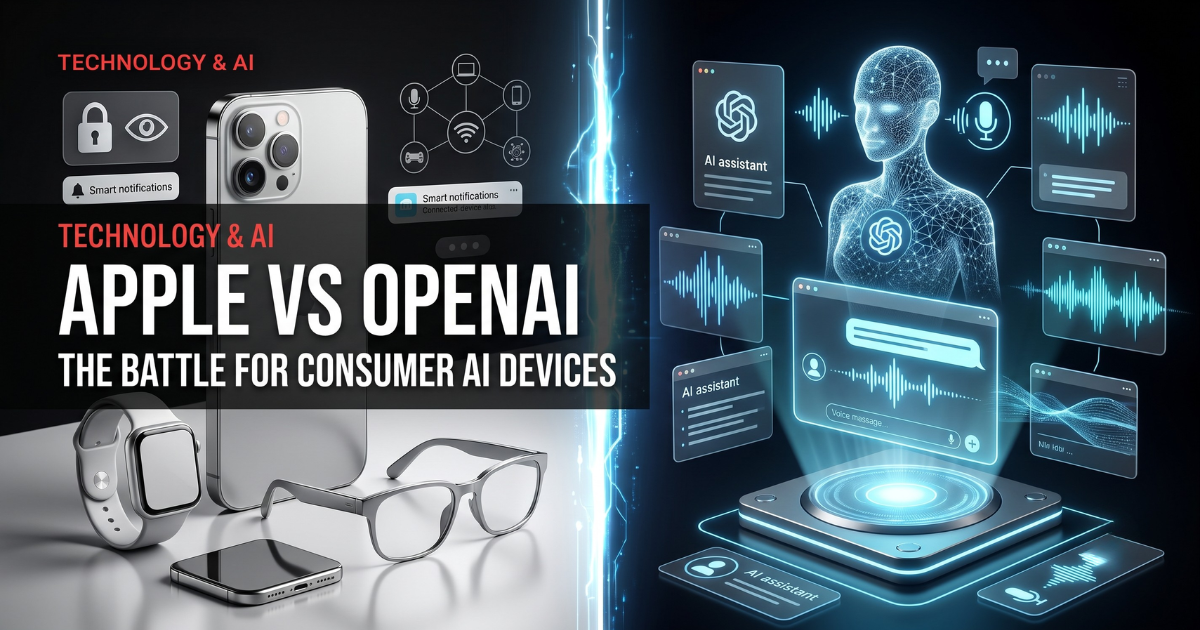
Apple and OpenAI are moving from uneasy technology partners to direct rivals in the race to define the next generation of consumer devices.
On July 10, 2026, Apple filed a federal lawsuit against OpenAI, its hardware subsidiary io Products and two former Apple employees. Apple alleges that confidential hardware information was improperly obtained and used to accelerate OpenAI’s expansion into consumer electronics.
OpenAI has rejected the allegations, saying it has no interest in other companies’ trade secrets and remains focused on developing innovative technology. The claims have not been proven in court.
The legal dispute arrives at a critical moment. OpenAI is reportedly developing a portable, screen-free smart speaker designed to work as an AI companion inside the home. Apple, meanwhile, is strengthening its existing ecosystem with a new generation of Apple Intelligence and a more capable Siri AI integrated across the iPhone, iPad, Mac, Apple Watch and Vision Pro.
This is therefore more than a disagreement over former employees or confidential files. The Apple OpenAI lawsuit may influence whether the future of consumer AI remains centered on smartphones or shifts toward a new category of always-available, context-aware devices.
What Is the Apple OpenAI Lawsuit About?
Apple’s complaint accuses OpenAI of using former Apple employees, recruitment activities and supplier relationships to obtain confidential information related to Apple’s hardware-development work.
The defendants include OpenAI Foundation, OpenAI Group PBC, io Products and former Apple employees Chang Liu and Tang Yew Tan. Tan previously held a senior Apple hardware role and later became involved in OpenAI’s consumer-device operation.
Apple alleges that the disputed information included sensitive material connected to:
- Hardware design and development
- Manufacturing processes
- Supplier relationships
- Product components
- Prototype work
- Internal engineering documents
- Future consumer-device plans
These remain Apple’s allegations. OpenAI and the individual defendants will have an opportunity to challenge the evidence and present their own accounts as the case develops.
OpenAI said after the filing that it had no interest in competitors’ trade secrets. The company has not publicly accepted Apple’s description of its hiring or hardware-development practices.
Why Is OpenAI Building Consumer Hardware?
OpenAI became one of the world’s most influential artificial intelligence companies through software products such as ChatGPT. However, relying entirely on smartphones, computers and operating systems controlled by other companies limits how directly OpenAI can reach consumers.
A dedicated OpenAI device could give the company greater control over:
- How people interact with ChatGPT
- Which sensors provide information to its models
- How voice conversations are handled
- When the assistant becomes active
- Which services and smart-home products it controls
- How subscriptions and other services are sold
- How user context is collected and processed
OpenAI formally merged with io Products in 2025. The hardware company was founded by former Apple design chief Jony Ive alongside Scott Cannon, Evans Hankey and Tang Tan.
OpenAI said the merged team would work closely with its research, engineering and product groups, while Ive and his design company LoveFrom would take significant creative and design responsibilities across OpenAI.
Reuters reported that OpenAI paid approximately $6.5 billion for io as part of its effort to develop devices designed specifically for the generative-AI era.
What Could the First OpenAI Device Be?
OpenAI has not publicly revealed a final product design, complete feature list or confirmed retail launch date.
However, reporting cited by Reuters indicates that the company’s first consumer product may be a portable, screen-free smart speaker. The device is reportedly intended to act more like a humanlike AI companion than a traditional speaker that simply plays music or answers basic questions.
Reported capabilities may include:
- Answering conversational questions
- Accessing ChatGPT features
- Controlling smart-home appliances
- Playing music and other media
- Reading or responding to messages
- Understanding a user’s surroundings
- Using cameras and sensors for context
- Providing proactive assistance
The device reportedly includes a camera and environmental sensors, allowing it to understand more about a room, nearby objects and the user’s current situation.
Earlier reporting suggested that OpenAI was considering a price between $200 and $300 and that commercial shipment might not begin before February 2027. These details remain unconfirmed and may change before launch.
Is the OpenAI Device an iPhone Replacement?
There is no confirmed evidence that OpenAI’s first product will immediately replace the iPhone or operate as a complete smartphone.
The reported smart-speaker concept appears to be designed primarily as an AI companion for the home. It may depend on internet connectivity, cloud-based AI models and links to other devices or services.
However, OpenAI’s wider ambition could challenge the role smartphones currently play in everyday digital life.
A sufficiently capable AI companion might reduce the need to:
- Open individual apps
- Search through menus
- Type messages manually
- Move between websites
- Check several notifications
- Use a screen for every task
- Learn different software interfaces
Instead, users could speak naturally, describe a goal and allow the AI system to choose the appropriate service or action.
That possibility is strategically important to Apple. The iPhone is not only a hardware product; it is the center of an ecosystem that includes apps, subscriptions, payments, accessories, cloud services and other Apple devices.
A successful screenless AI device would not need to replace every smartphone function to affect that ecosystem. It would only need to become the user’s preferred starting point for common digital tasks.
Apple’s Strategy: Put AI Inside Existing Devices
Apple’s response to the AI transition is very different from OpenAI’s reported approach.
Rather than asking consumers to adopt an entirely new product category, Apple is integrating AI into devices and software that millions of customers already use.
At WWDC on June 8, 2026, Apple introduced a new generation of Apple Intelligence and an extensively redesigned Siri AI. Apple says the assistant is deeply integrated across the iPhone, iPad, Mac, Apple Watch and Vision Pro.
Siri AI is designed to:
- Understand personal context
- Search messages, emails and photos
- Recognize information shown on the screen
- Complete actions across apps
- Answer broad questions using web information
- Maintain conversational history
- Work across several Apple devices
Apple is positioning privacy and system integration as central advantages. The company says its new AI architecture is designed to protect user information while allowing Siri to access relevant personal context.
The competition can therefore be described as two different visions.
Apple’s vision: AI becomes a more capable layer across the devices consumers already own.
OpenAI’s reported vision: AI deserves a new physical device designed around conversation, awareness and continuous assistance.
Why Jony Ive Matters to the Competition
Jony Ive spent decades helping Apple establish its reputation for product design.
His work influenced major products such as the iMac, iPod, iPhone, iPad and Apple Watch. His involvement gives OpenAI access to experience in industrial design, materials, manufacturing and consumer-product development.
Ive’s role also adds symbolic significance to the dispute.
OpenAI is not merely hiring an outside design consultant. It has combined its AI models with a hardware group containing several people who previously worked on Apple products. OpenAI’s official announcement said that many members of the io team had worked together for decades.
Apple’s lawsuit does not establish that former employees are prohibited from using their general skills or professional experience. California generally allows employees to move between competing companies.
The legal issue is whether specific protected information—not general expertise—was improperly taken or used.
That distinction will be central to the case. A former Apple engineer can legally apply knowledge gained through professional experience, but cannot lawfully take protected files, confidential designs or trade secrets belonging to Apple.
Why Apple May See OpenAI Hardware as a Serious Threat
Several companies have tried to create AI-first consumer devices, with mixed results. A new product category does not become successful simply because it includes an advanced language model.
OpenAI nevertheless presents a different type of competitive challenge.
OpenAI Already Has a Large Consumer Brand
ChatGPT has made OpenAI a recognizable consumer-technology name. The company would not need to introduce both a new device and an unknown AI service at the same time.
Jony Ive Brings Product Experience
OpenAI’s hardware team includes people with experience creating and manufacturing widely adopted consumer electronics.
AI Could Change the User Interface
Traditional smartphones depend on icons, touchscreens, menus and individual applications. A conversational AI system can replace some of those steps with direct requests.
OpenAI Wants a Direct Customer Relationship
A dedicated device could allow OpenAI to control the user experience instead of operating as an application inside Apple’s ecosystem.
Consumer AI May Become Proactive
The reported use of cameras and sensors suggests that OpenAI’s device may attempt to understand context and offer help without waiting for a detailed prompt.
These potential advantages do not guarantee success. They do explain why Apple may view OpenAI’s hardware expansion as more consequential than the launch of another ordinary smart speaker.
Apple and OpenAI Are Both Partners and Competitors
The relationship between Apple and OpenAI has already shown how quickly AI alliances can change.
Apple previously integrated access to ChatGPT into parts of its software experience. At the same time, Apple continued developing its own models, privacy infrastructure and assistant features.
The companies benefited from cooperation because Apple needed access to advanced generative-AI capabilities, while OpenAI gained distribution through popular Apple products.
The new lawsuit demonstrates the limits of that cooperation.
OpenAI increasingly wants to control consumer hardware. Apple increasingly wants its own AI system to become the main assistant across its ecosystem. Their interests now overlap in areas including:
- Voice assistants
- Personal AI
- Smart-home control
- Consumer hardware
- Search and information discovery
- Messaging
- App-based actions
- AI subscriptions
- Wearable technology
The two companies may still cooperate in selected software areas while competing aggressively in hardware. Technology companies frequently maintain partnerships and rivalries at the same time.
Could Apple Stop the OpenAI Device?
Apple cannot unilaterally cancel or block an OpenAI product.
It must persuade a court that its trade secrets were misappropriated and that legal relief is justified.
Possible outcomes could include:
- The lawsuit being dismissed
- A confidential settlement
- Financial damages
- Restrictions on the use of specific information
- Changes to OpenAI’s development process
- Delays while disputed materials are reviewed
- Court orders affecting certain employees or technologies
- A trial examining Apple’s evidence and OpenAI’s defenses
An injunction could create serious difficulties if it restricted OpenAI’s ability to use disputed designs, documents or development work. However, a court would normally need to consider the strength of Apple’s evidence, the risk of harm and the impact of the requested order.
The existence of a lawsuit does not prove that OpenAI’s device contains Apple technology. It also does not mean the product will definitely be delayed or canceled.
What OpenAI Must Prove to Consumers
Even without the legal dispute, OpenAI faces substantial challenges in consumer hardware.
Clear Everyday Value
The device must perform useful tasks better than a smartphone, smart speaker or wearable.
Consumers are unlikely to buy another connected device simply because it includes ChatGPT.
Privacy and Trust
A product equipped with cameras, microphones and environmental sensors could understand a user’s surroundings in powerful ways.
It could also create concern about recording, data retention, security and how personal information is used.
OpenAI would need clear controls showing:
- When the device is listening
- When cameras are active
- Which data is stored
- Whether information is used for training
- How recordings can be deleted
- Whether processing happens locally or in the cloud
- How other household members are protected
Reliable Responses
An AI companion cannot frequently misunderstand commands, invent information or take unintended actions.
Reliability becomes especially important when the device can control appliances, send messages or perform actions on the user’s behalf.
Battery and Connectivity
A portable product must offer dependable battery life and remain useful when internet access is weak or unavailable.
A Sustainable Business Model
OpenAI must decide whether the device will rely on hardware profit, a ChatGPT subscription, paid services or a combination of these approaches.
What Apple Must Prove in the AI Era
Apple also faces significant pressure.
The company has enormous advantages in hardware, software distribution, privacy infrastructure and customer loyalty. However, it must show that Siri AI can compete with increasingly capable conversational systems.
Apple’s challenge is to deliver an assistant that feels:
- Fast
- Accurate
- Context-aware
- Consistent across devices
- Useful inside third-party apps
- Trustworthy with personal information
- Capable of completing real tasks
Apple introduced Siri AI as a more conversational and personally aware assistant capable of searching across a user’s information and taking actions throughout the operating system. Its beta release is planned for supported users later in 2026.
If Siri AI performs well, Apple may be able to offer many of the benefits of an AI companion without convincing consumers to purchase another device.
If it falls behind, a dedicated OpenAI device could appear more attractive.
Screen-Based AI Versus Ambient AI
The Apple–OpenAI rivalry represents a broader change in how people may interact with technology.
Screen-Based AI
Apple’s current strategy keeps the screen and existing device ecosystem at the center.
Users can speak to Siri AI, but they can also view results, edit information, open apps and confirm actions visually.
Advantages include:
- Familiar hardware
- Visual confirmation
- Established privacy controls
- Existing apps and services
- Mature accessibility features
Ambient AI
OpenAI’s reported device appears closer to ambient computing.
An ambient AI system exists in the user’s environment, understands spoken requests and may use cameras or sensors to interpret what is happening.
Potential advantages include:
- Less screen dependence
- More natural conversation
- Immediate contextual assistance
- Hands-free interaction
- Proactive recommendations
Its risks include surveillance concerns, accidental activation, unclear consent and dependence on cloud services.
The market may not choose only one model. Consumers could use smartphones for visual and private tasks while relying on ambient devices for conversation, home control and routine assistance.
Could OpenAI Succeed Where Other AI Devices Failed?
Early AI-first gadgets have shown that strong AI branding does not automatically create a useful product.
Consumer devices can fail because they are too slow, unreliable, expensive or limited compared with a smartphone.
OpenAI has several potential advantages:
- Direct access to its latest AI models
- An established ChatGPT user base
- Jony Ive’s design leadership
- Experienced former consumer-hardware engineers
- Strong investor support
- A recognizable global brand
However, it faces the same basic test as every hardware company: the final product must be useful enough to justify its price and its place in a customer’s life.
A beautifully designed device will not succeed if users cannot trust its answers, protect their privacy or understand why it is better than an existing phone.
What the Lawsuit Means for the Future of AI Devices
The lawsuit could influence more than one OpenAI product.
First, it may define how courts distinguish legitimate employee mobility from trade-secret theft in the highly competitive AI industry.
Second, it may affect how companies recruit engineers from rivals. AI laboratories and hardware companies are competing for a relatively small number of experienced researchers, chip specialists and product designers.
Third, the case could reveal previously confidential information about the development of consumer AI devices through court filings and discovery.
Finally, it may determine how quickly OpenAI can enter hardware without facing restrictions connected to former Apple employees or disputed information.
The larger competition will continue regardless of the final judgment. Apple, OpenAI, Google, Meta, Amazon and other technology companies all have reasons to build the primary interface through which consumers access AI.
Frequently Asked Questions
Why did Apple sue OpenAI?
Apple alleges that OpenAI and two former Apple employees improperly obtained or used confidential hardware information to accelerate OpenAI’s consumer-device development. OpenAI denies having an interest in Apple’s trade secrets.
What is the OpenAI device?
OpenAI’s first consumer device is reportedly a portable, screen-free smart speaker with cameras and sensors. It may function as an AI companion using ChatGPT, but OpenAI has not publicly confirmed a final design or feature list.
Is Jony Ive working for OpenAI?
Ive and his design company LoveFrom remain independent but have taken major design and creative responsibilities across OpenAI. The io Products team officially merged with OpenAI in 2025.
When will the OpenAI device launch?
Reports suggest the product could be unveiled in 2026 and may not ship before 2027. OpenAI has not confirmed a final commercial release date.
Will the OpenAI device replace the iPhone?
There is no evidence that the first product will fully replace a smartphone. It is reportedly being designed as a screen-free AI companion, but future versions could reduce users’ dependence on phone screens and individual apps.
What is Siri AI?
Siri AI is Apple’s redesigned assistant powered by the next generation of Apple Intelligence. Apple says it can understand personal context, interpret onscreen information, search across apps and complete systemwide actions.
Has Apple proven that OpenAI stole trade secrets?
No. Apple has made allegations in a civil lawsuit, but those allegations have not yet been proven in court.
Could the lawsuit delay OpenAI hardware?
It could create delays if the court restricts specific development work or if OpenAI must review disputed materials. However, no final ruling has established that the product must be delayed or canceled.
Final Thoughts
The conflict between Apple and OpenAI is becoming one of the most important battles in consumer technology.
Apple wants artificial intelligence to strengthen the iPhone and the wider ecosystem consumers already use. OpenAI appears to believe that advanced AI deserves a new type of device built around conversation, context and continuous assistance.
Apple’s lawsuit adds legal uncertainty to that competition, but the larger issue extends beyond confidential files or former employees.
The real contest is over who will control the main consumer interface for artificial intelligence.
Will AI remain a feature inside smartphones, computers and wearables? Or will a dedicated OpenAI device create a new category that makes screens and traditional apps less central?
The answer will depend not only on the lawsuit, but also on product quality, privacy, reliability, pricing and whether consumers genuinely want an AI companion that can see, listen and understand the environment around them.