
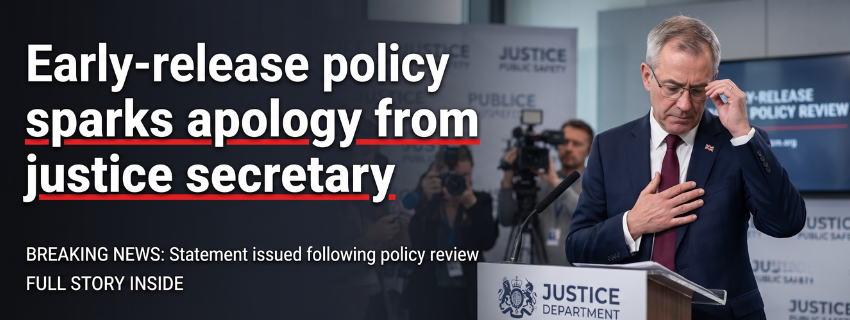
The UK government’s revised prisoner early-release policy has sparked strong criticism from victims’ families, prompting Justice Secretary Alex Norris to issue a public apology.
While the government argues that the changes are necessary to prevent a prison overcrowding crisis in England and Wales, many bereaved families believe the policy undermines justice and fails to adequately consider the impact on victims.
Here’s everything you need to know about the revised early-release scheme, why it has caused controversy, and what it means for prisoners, victims, and the justice system.
Why Is the UK Changing Its Prison Early-Release Policy?
The government says prisons in England and Wales are operating under significant capacity pressure.
Without changes to prisoner release rules, ministers warn that overcrowding could become severe enough to threaten the effective operation of the prison system and potentially increase risks to public safety.
To address this issue, the revised policy will gradually allow eligible prisoners serving fixed-term sentences to be released earlier while remaining under licence and supervision.
However, the proposal has been met with widespread concern from victims’ families and criminal justice organisations.
Victims’ Families Say Justice Is Being Undermined
Several high-profile families have spoken publicly against the revised policy, arguing that early release diminishes accountability for serious crimes.
Many say they fear offenders could return to the community sooner than expected without victims receiving sufficient support or notice.
Family of PC Andrew Harper Speaks Out
Among the most vocal critics is Debbie Adlam, the mother of PC Andrew Harper, who was killed in 2019 after being dragged behind a vehicle while responding to the theft of a quad bike in Berkshire.
Although the driver, Henry Long, is not eligible for early release under the scheme, concerns remain that Jessie Cole and Albert Bowers, who were convicted of manslaughter, could still qualify.
Adlam said she was “devastated” by the possibility and confirmed that Justice Secretary Alex Norris personally contacted her to explain the government’s position and apologise.
She also urged authorities to ensure:
- Families receive advance notice of any release.
- Victims have access to probation support.
- Better communication exists throughout the release process.
PC Harper’s widow, Lissie Harper, described the situation as “disgusting,” while Thames Valley Police Chief Constable Jason Hogg said the policy would be deeply demoralising for police officers.
Other Bereaved Families Raise Concerns
Other families affected by violent crime have also criticised the government’s approach.
Calvin Buckley, whose partner Frankie Jules-Hough and unborn child were killed in a road collision in 2023, argued that victims should not bear the burden of solving prison overcrowding.
Similarly, Claire Corkery, whose parents Sue and Tom Corkery died after being struck by a speeding driver in 2024, questioned whether the revised policy sends the message that some victims’ lives are valued less than others.
Which Offenders Will No Longer Qualify?
Following public criticism, the government announced significant changes to the original proposal.
The revised scheme now excludes offenders convicted of:
- Rape
- Grooming offences
- Serious child sexual offences
According to ministers, these additional exclusions mean approximately 1,000 prisoners who were previously expected to qualify will now remain in custody until their existing release dates.
Why the Government Says Broader Exemptions Are Not Possible
Despite growing pressure from campaigners, the government insists that expanding the list of excluded offences further could create a serious prison capacity crisis.
Prime Minister Andy Burnham acknowledged the public’s “anger, anxiety and distress” but warned that overcrowded prisons could ultimately increase risks to public safety.
Justice Secretary Alex Norris also stressed that while additional exclusions had been introduced, extending them much further could undermine the purpose of the reforms.
How the New Early-Release Scheme Will Work
The revised policy will begin in October and will be introduced gradually over several stages.
Rather than applying to every eligible prisoner immediately, releases will occur in controlled phases to manage prison populations safely.
Government officials estimate that approximately:
- 5,000 additional prisoners will be released through the scheme.
- Around 4,500 prisoners already leave prison each month under existing arrangements.
The Prison Governors’ Association has warned that recalculating sentence eligibility may place significant additional pressure on prison and probation services.
Who Will Be Eligible for Earlier Release?
Eligibility is primarily based on sentence length rather than the specific offence committed.
Prisoners serving four years or longer
Eligible prisoners serving sentences of four years or more for certain offences may become eligible for release after serving half of their sentence, instead of the previous two-thirds.
Prisoners serving shorter sentences
Those serving shorter custodial sentences could become eligible for release after serving one-third of their sentence, rather than half.
Gradual rollout
The reforms will initially apply to prisoners serving sentences below 575 days before expanding in stages to include those serving sentences of up to 12 years by June 2027.
Stronger Supervision After Release
The government says early release does not mean offenders are free from supervision.
Everyone released under the scheme will remain on licence and must comply with strict conditions.
In addition, offenders convicted of rape or serious child sexual offences who complete their full prison terms will face strengthened monitoring and supervision once released into the community.
Additional Support for Victims
Alongside the revised policy, the government has announced increased investment in victim services.
New measures include:
- £10 million in additional funding for front-line victim support organisations.
- A new national victim support helpline.
- Greater consultation with victims before eligible prisoners are released.
- Improved communication between probation services and affected families.
Why the Policy Remains Controversial
Although ministers argue the reforms are necessary to prevent overcrowding, many victims’ families believe prison capacity issues should not come at the expense of justice.
The debate highlights the difficult balance between:
- Maintaining public safety.
- Managing prison overcrowding.
- Protecting victims’ rights.
- Supporting rehabilitation.
- Preserving confidence in the criminal justice system.
As the policy begins rolling out later this year, its implementation and impact are likely to remain under close public and political scrutiny.
Key Takeaways
- Justice Secretary Alex Norris apologised to victims’ families over the revised prisoner early-release policy.
- The government says the reforms are necessary to prevent a prison overcrowding crisis in England and Wales.
- Offenders convicted of rape, grooming, and serious child sexual offences have now been excluded from early release.
- Around 1,000 prisoners are expected to lose eligibility following the revised exclusions.
- The phased rollout begins in October and expands gradually through June 2027.
- Eligible prisoners may serve a smaller proportion of their sentence before being released on licence.
- The government has pledged £10 million in additional funding for victim support and plans to launch a national helpline.
- Victims’ families continue to argue that early release weakens accountability and diminishes justice.
Frequently Asked Questions (FAQs)
What is the UK’s revised prisoner early-release policy?
The policy allows certain prisoners serving fixed-term sentences to be released earlier than under previous rules while remaining on licence and subject to supervision. The reforms will be introduced gradually from October.
Why are victims’ families opposed to the policy?
Many families believe earlier release reduces accountability for serious offences and causes additional emotional distress. They also want better communication and support before offenders are released.
Which offenders are excluded from the scheme?
The revised policy excludes prisoners convicted of rape, grooming offences, and serious child sexual offences from qualifying for early release.
Why is the government introducing these reforms?
The government says overcrowding in prisons has reached a critical level. Ministers argue that carefully managed early releases are necessary to maintain prison capacity and protect public safety.
Will prisoners released early still be supervised?
Yes. Prisoners released under the scheme will remain on licence and must comply with strict conditions. Breaching those conditions could result in being returned to prison.
What support will victims receive?
The government has announced an additional £10 million for victim support services, enhanced consultation with affected families, and the creation of a new national victim support helpline.