
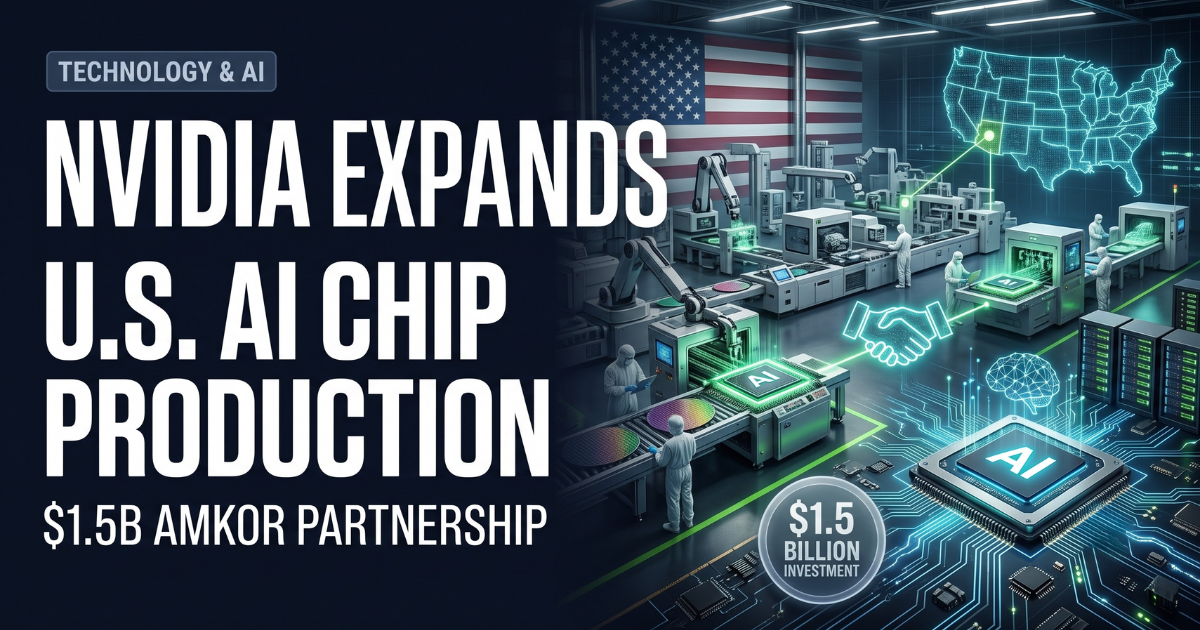
Nvidia is expanding the American supply chain for its artificial intelligence processors through a major new partnership with semiconductor packaging company Amkor Technology.
On July 23, 2026, Amkor announced a multiyear strategic agreement with Nvidia valued at $1.5 billion. The partnership will support the development of advanced packaging and testing technologies for future AI and accelerated-computing platforms.
Under the agreement, Nvidia will provide Amkor with a prepayment to help expand advanced semiconductor packaging capacity in the United States, particularly in Arizona. The companies will also align their long-term technology plans around high-density interconnects and next-generation methods for combining different chip components inside one package.
The deal represents another step in Nvidia’s broader effort to manufacture more AI infrastructure in the United States. However, it is important to understand that the partnership is focused mainly on chip packaging and testing—not the initial fabrication of silicon wafers.
That distinction matters because advanced packaging has become one of the most important and capacity-constrained stages in the production of modern Nvidia AI chips.
What Did Nvidia and Amkor Announce?
The Nvidia Amkor partnership is a multiyear advanced packaging, testing and technology-development agreement.
Amkor already provides packaging services for several Nvidia product categories, including data-center processors, networking chipsets and accelerated-computing systems. The expanded relationship is intended to bring new packaging technologies into high-volume production as global demand for AI infrastructure continues to grow.
The agreement includes three major elements:
- A $1.5 billion multiyear commercial and development commitment
- An Nvidia prepayment supporting Amkor’s U.S. capacity expansion
- Joint development of packaging and testing technologies for future AI platforms
The two companies will work on technologies such as high-density interconnects and heterogeneous integration. These methods allow different types of processors, memory components and specialized chiplets to operate together as one highly integrated computing package.
Amkor said the collaboration will span both Asia and the United States. This means the deal is not a complete transfer of Nvidia’s supply chain out of Asia. Instead, it adds substantial U.S. capacity while preserving a geographically diversified manufacturing network.
Why Advanced Packaging Matters for Nvidia AI Chips
A modern AI processor is no longer simply one piece of silicon placed inside a basic protective case.
Advanced AI systems increasingly combine multiple processor dies, memory components, networking technology and high-speed connections inside a single package. The quality of that packaging can directly affect computing performance, energy efficiency, reliability and the speed at which data moves between components.
Amkor described advanced packaging as essential to the performance, efficiency and system-level integration required by modern AI infrastructure.
This is especially important for Nvidia’s data-center platforms, which are designed to train and run increasingly large artificial intelligence models.
Even when enough processor wafers are available, limited packaging capacity can restrict how quickly finished AI accelerators reach data centers. A chip cannot be installed in a server until it has been packaged, connected, tested and verified.
The new partnership therefore addresses a part of semiconductor production that receives less public attention than wafer fabrication but remains essential to increasing the supply of finished Nvidia AI chips.
Is Nvidia Building the Chips in America?
Partly—but the complete answer involves several manufacturing stages.
Nvidia designs its AI chips but relies on specialized partners to manufacture, package, test and assemble them into computing systems.
TSMC is producing Nvidia Blackwell wafers at its semiconductor facility in Phoenix, Arizona. Amkor’s planned Arizona campus will provide advanced packaging and testing services, while partners such as Wistron and Foxconn are expanding U.S. production of Nvidia AI systems and supercomputers in Texas.
A simplified American production chain could eventually look like this:
- Nvidia designs the processor and computing platform.
- TSMC manufactures the silicon wafers in Arizona.
- Amkor packages and tests the chips in Arizona.
- Manufacturing partners assemble the chips into servers and AI systems in Texas.
- Data-center operators install the systems inside U.S. AI facilities.
Nvidia has said it plans to produce up to $500 billion of AI infrastructure in the United States through partnerships with companies including TSMC, Amkor, Foxconn, Wistron, Corning, Lumentum and Coherent.
The new Amkor agreement strengthens the packaging stage of that supply chain.
Where Will the New Packaging Capacity Be Located?
The agreement supports Amkor’s U.S. advanced packaging expansion, including its new campus in Peoria, Arizona.
Amkor is developing the campus on an initial 104-acre site and has secured an additional 67-acre parcel for potential future expansion. The company expects the campus to become the first high-volume outsourced semiconductor assembly and testing facility of its kind in the United States.
The larger project is planned in two phases and carries an estimated total investment of up to $7 billion. When both phases are completed, the campus is expected to include more than 750,000 square feet of cleanroom space and support as many as 3,000 jobs.
Construction of the first manufacturing facility is expected to be completed in mid-2027, with production currently planned to begin in early 2028. These dates remain forward-looking and could change because of construction, equipment, regulatory or market conditions.
The campus is being developed near TSMC’s Arizona semiconductor operations, allowing manufactured wafers to move more efficiently into domestic packaging and testing.
How the Nvidia Deal Fits With Amkor’s TSMC Partnership
The Nvidia agreement is part of a broader network of semiconductor partnerships developing around Arizona.
In June 2026, Amkor and TSMC announced a separate 10-year agreement to expand advanced packaging and testing capacity in the United States. Under that arrangement, TSMC will procure packaging and test services from Amkor to support customers using its American fabrication facilities.
Together, the two agreements could create a more integrated production chain:
- TSMC manufactures advanced wafers.
- Amkor packages and tests the resulting processors.
- Nvidia integrates those components into AI computing platforms.
- Other U.S. partners assemble complete systems and server infrastructure.
Amkor and TSMC said their collaboration is intended to provide customers with a full American supply chain extending from advanced silicon manufacturing to packaged and tested semiconductor devices.
This integration may reduce the need to send some U.S.-manufactured wafers overseas for packaging before bringing finished chips back to the United States.
Why Nvidia Wants More U.S. Manufacturing
Nvidia’s decision reflects both commercial demand and growing concern about semiconductor supply-chain concentration.
Strong Demand for AI Infrastructure
Technology companies, cloud providers, governments and research organizations are spending heavily on computing infrastructure capable of training and running advanced AI models.
Nvidia and Amkor said their expanded partnership is intended to bring packaging technologies to market at scale as demand for AI infrastructure increases.
Adding packaging capacity may help Nvidia support more data-center processors, networking products and accelerated-computing systems.
A More Resilient Supply Chain
Much of the world’s advanced semiconductor production and packaging capacity has historically been concentrated in Asia.
A geographically diverse supply chain gives Nvidia more options when production is disrupted by transportation problems, natural disasters, trade restrictions or geopolitical tension.
The company has said that adding American manufacturing can strengthen supply-chain resilience while helping it meet rising demand for AI chips and supercomputers.
Closer Coordination Between Suppliers
Locating wafer fabrication and packaging operations within the same region can improve coordination between companies.
TSMC’s Arizona fabs and Amkor’s Peoria packaging campus are being developed as complementary parts of an end-to-end semiconductor ecosystem.
Government Support for Domestic Chips
Amkor’s Arizona campus has received support through the federal CHIPS for America program, manufacturing tax incentives and state and local government programs.
The public support reflects Washington’s broader effort to increase domestic semiconductor capacity and reduce dependence on overseas production for strategically important technologies.
What Is Heterogeneous Integration?
Heterogeneous integration is a semiconductor packaging approach that combines different types of components into one system.
Instead of producing every function on one enormous chip, manufacturers can combine specialized dies designed for different tasks.
A package might include:
- Graphics processing units
- High-bandwidth memory
- Networking components
- Input and output dies
- Specialized accelerators
- High-speed interconnect technology
This approach can improve performance and allow companies to mix components produced using different manufacturing processes.
The Nvidia-Amkor agreement specifically identifies next-generation heterogeneous integration and high-density interconnects as areas of collaboration.
For AI systems, faster communication between processors and memory is particularly important because advanced models must move enormous quantities of data during training and inference.
Will the Partnership Increase Nvidia Chip Supply?
The partnership is intended to expand capacity, but it will not create an immediate increase in retail or data-center chip availability.
Several steps must occur first:
- Amkor must complete new manufacturing space.
- Specialized packaging equipment must be installed.
- Production processes must be tested and qualified.
- Nvidia and Amkor must validate future packaging technologies.
- The facilities must achieve reliable high-volume output.
The first production at Amkor’s new Arizona campus is currently expected in early 2028.
The agreement may therefore have a greater effect on Nvidia’s medium- and long-term supply than on chip availability during the remainder of 2026.
It could also support future Nvidia platforms rather than only increasing production of chips already on the market.
Will Nvidia AI Chips Become Cheaper?
The deal does not guarantee lower prices for Nvidia GPUs or AI systems.
Domestic packaging could reduce certain transportation risks and strengthen supply reliability, but American factories also face high construction, equipment, energy and labor costs.
The price of an AI accelerator depends on many factors, including:
- Manufacturing yields
- Memory supply
- Packaging capacity
- Customer demand
- Product performance
- Competition
- Development expenses
- Data-center demand
- Export controls
Increased capacity can eventually reduce supply constraints, but it may also be used to support more powerful and expensive next-generation products.
For that reason, the new partnership should be viewed primarily as a production-capacity and supply-chain development—not a promise of cheaper Nvidia chips.
What the Partnership Means for Arizona
Arizona is becoming a central location in America’s advanced semiconductor strategy.
The state already hosts major operations or investments from TSMC, Intel and Amkor. Amkor’s packaging campus is designed to complement nearby wafer fabrication and provide a missing back-end stage of the production process.
The company’s planned two-phase development could support as many as 3,000 jobs once completed. The project will require employees in areas such as engineering, equipment maintenance, quality control, operations, automation, facilities management and semiconductor testing.
However, those employment and investment figures apply to the wider Amkor campus plan. They should not be interpreted as jobs created exclusively by Nvidia’s $1.5 billion agreement.
How the Deal Fits Nvidia’s Broader American Expansion
The Amkor agreement is only one part of Nvidia’s growing U.S. manufacturing network.
In July 2026, Wistron opened a 324,000-square-foot manufacturing plant in Fort Worth, Texas. The facility is already producing Nvidia GB300 Grace Blackwell Ultra Superchips and is preparing to manufacture systems based on Nvidia’s Vera Rubin platform.
Nvidia has also described plans involving:
- TSMC wafer production in Phoenix
- Amkor packaging and testing in Arizona
- Foxconn AI system production in Houston
- Wistron manufacturing in Texas
- Corning optical-connectivity production
- Lumentum and Coherent networking technologies
- U.S. AI factory and data-center development
The company says its supplier and partner network now extends across 43 states.
These investments show that producing AI infrastructure requires more than processor fabrication. It also depends on packaging, networking, optical components, cooling, power equipment, server assembly and data-center construction.
Could the Partnership Reduce America’s Dependence on Asia?
The deal can reduce some dependence, but it will not eliminate Nvidia’s Asian supply chain.
Amkor’s announcement states that the expanded collaboration spans both Asia and the United States. Nvidia also continues to rely on manufacturing expertise, components and capacity located across Taiwan, South Korea and other Asian markets.
The practical objective is therefore diversification rather than complete separation.
A stronger American production base could give Nvidia:
- More packaging capacity
- Additional geographic flexibility
- A domestic option for strategically important customers
- Better integration with TSMC’s Arizona fabs
- Reduced exposure to certain shipping disruptions
- A more resilient global supply network
At the same time, Asia will continue playing a major role in semiconductor manufacturing, packaging, memory production and electronics assembly.
What Are the Main Risks?
The partnership is significant, but several challenges could affect its outcome.
Construction and Equipment Delays
Advanced semiconductor facilities require specialized cleanrooms, machinery, utilities and environmental controls. Delays in construction or equipment installation could postpone production.
Workforce Availability
Chip packaging and testing facilities need experienced engineers, technicians and manufacturing specialists. Recruiting and training enough qualified workers may take time.
Rapid Technology Changes
AI chips are developing quickly. Packaging methods being designed today must remain suitable for future processors, memory systems and cooling requirements.
Manufacturing Yield
A facility must produce packaged chips consistently and at high quality. Low yields during early production can increase costs and restrict output.
Demand Fluctuations
Current demand for AI infrastructure is extremely strong, but long-term customer spending can change because of economic conditions, competition or slower returns from AI investment.
Execution Risk
Amkor itself cautioned that there is no guarantee its Arizona campus will be completed on the expected timeline, at the anticipated cost or with all the projected benefits.
Why This Deal Matters
The Nvidia-Amkor agreement matters because advanced packaging is becoming as strategically important as the manufacture of the silicon itself.
Nvidia can design increasingly powerful processors, and TSMC can manufacture advanced wafers, but those components must still be integrated and tested before they can power an AI data center.
The $1.5 billion agreement gives Amkor additional financial support to expand that capability in the United States. It also connects Nvidia’s technology roadmap more closely with Amkor’s packaging-development plans.
If the partnership develops as planned, Arizona could support several major stages of AI chip production—from wafer fabrication at TSMC to packaging and testing at Amkor.
That would represent an important step toward a more complete American semiconductor supply chain.
Frequently Asked Questions
What is Nvidia’s new partnership?
Nvidia has entered a multiyear strategic agreement with Amkor Technology to develop and expand advanced packaging and testing capacity for next-generation AI and accelerated-computing platforms.
How much is the Nvidia-Amkor deal worth?
The agreement is valued at $1.5 billion. Nvidia will provide a prepayment supporting the expansion of Amkor’s U.S. advanced packaging capacity.
Where will Nvidia chips be packaged?
The agreement supports U.S. packaging capacity in Arizona. Amkor is developing a major advanced packaging and testing campus in Peoria.
When will Amkor’s Arizona plant begin production?
Amkor currently expects construction of the first facility to finish in mid-2027, with production beginning in early 2028. The timeline remains subject to change.
Does Amkor manufacture Nvidia’s silicon wafers?
Amkor focuses primarily on semiconductor packaging and testing. TSMC manufactures Nvidia Blackwell wafers at its Phoenix facility.
Will Nvidia chips be completely made in the United States?
Some Nvidia products could eventually move through several U.S.-based production stages, including wafer fabrication, packaging, testing and system assembly. However, Nvidia will continue using a global supply chain that includes major operations in Asia.
Will the deal make Nvidia GPUs cheaper?
There is no guarantee of lower prices. The partnership is primarily designed to increase advanced packaging capacity, support future AI platforms and strengthen supply-chain resilience.
What does Amkor Technology do?
Amkor is a U.S.-headquartered provider of outsourced semiconductor packaging and testing services. Its technologies are used for products including AI processors, data-center chips, smartphones, vehicles and communications equipment.
Final Thoughts
Nvidia’s $1.5 billion partnership with Amkor is a major step in the expansion of American AI chip manufacturing.
The agreement does not create a new Nvidia wafer fabrication plant. Instead, it strengthens an equally important stage of production: advanced packaging and testing.
By supporting Amkor’s Arizona expansion, Nvidia is helping create a more integrated U.S. semiconductor supply chain connecting TSMC wafer fabrication, Amkor packaging and testing, and AI system assembly by manufacturing partners in Texas.
The benefits will not appear immediately. Amkor’s first new Arizona production facility is currently expected to begin operating in early 2028. However, the agreement could provide Nvidia with more domestic capacity, stronger supply-chain resilience and additional support for future generations of AI processors.
As demand for Nvidia AI chips grows, the ability to package and test advanced processors at scale may become just as important as the ability to design or fabricate them.