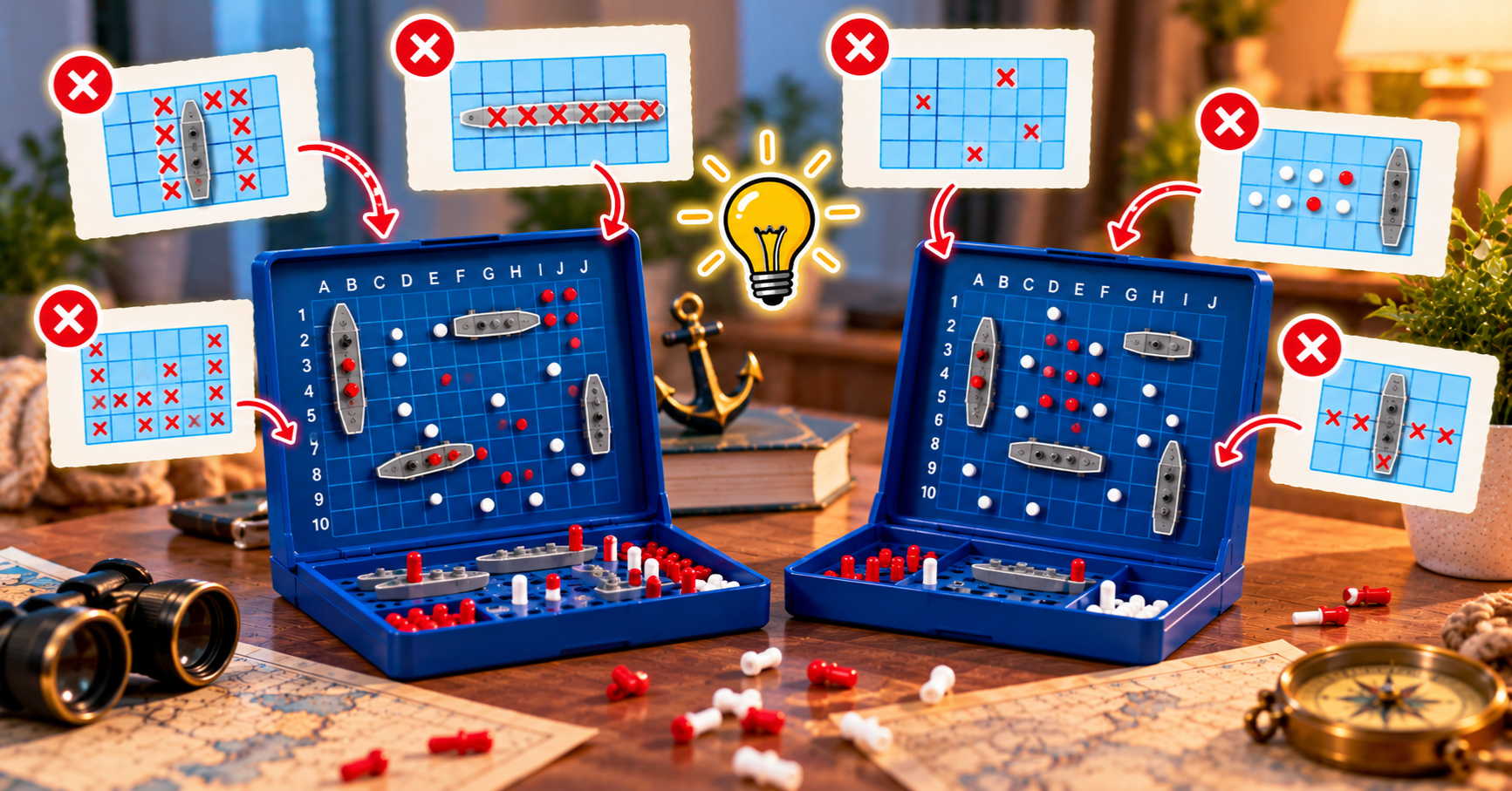
It is easy to lose track of what you know during a Battleship game. A few hits appear, several misses crowd the grid, and the next shot starts to feel like a guess again. The trick is to use the information the board has already given you. Whether you play Battleship on a tabletop or play Battleship online, these seven common mistakes are worth watching.
- Firing at a square you already tested. A repeat shot usually teaches you nothing new. Before choosing a coordinate, check your marked grid. Online play may make repeat shots impossible or flag them for you, but reviewing the board still prevents you from wasting thought on a square you already understand.
- Ignoring a fresh hit. When you hit a ship, the untested spaces directly above, below, left, and right of that square become useful. Ships in the familiar game run straight horizontally or vertically, so a shot far across the board may be less informative while you still need to identify the vessel you found.
- Searching diagonally for the same ship. A straight ship cannot continue diagonally from a hit. A diagonal square might contain another ship, depending on the rules, but it will not extend the vessel you are tracing. Use adjacent row and column squares to discover its direction.
- Assuming every nearby hit belongs to one ship. Rules about ships touching vary by version. If neighboring ships are permitted, two adjacent hits are not always part of the same vessel. Watch for the sunk-ship message or other feedback and avoid treating an unconfirmed pattern as a certainty.
- Forgetting which ships remain. The size of the remaining fleet changes where a shot is useful. If only a long ship is still afloat, a tiny isolated gap may be impossible for it to occupy. If a shorter ship remains, that same gap may still deserve attention. Review the game's ship list before deciding an area is empty.
- Reusing an obvious fleet layout. Placing every ship against the edge, keeping them all parallel, or repeating last game's setup can make you more predictable against someone who knows your habits. Try different legal placements. Any strategy must respect the version's grid and spacing rules.
- Changing plans without using the evidence. A search pattern can help when the board is mostly unknown. After a hit, however, your local evidence should take priority. Likewise, if most of the fleet is sunk, the remaining ship sizes should guide the final search. Adapt your plan to the information you have rather than following one pattern for the whole match.
Try a free Battleship game on Entertainment Couch and focus on one habit: before every shot, say what result would teach you. A miss can be useful if it rules out a likely ship placement. A hit can be useful if you follow it up with the right question. That is how the grid starts telling a story.