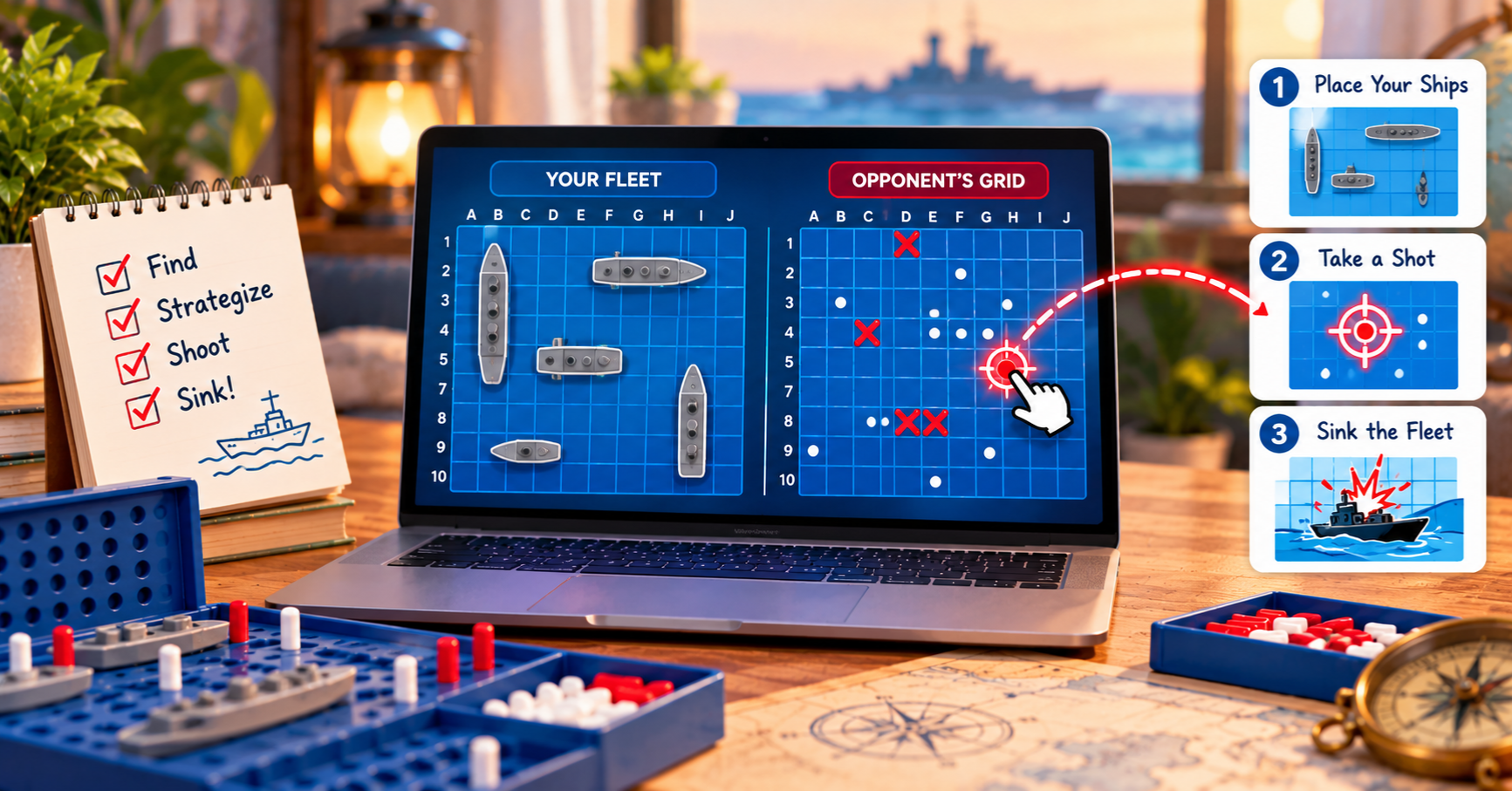
Every shot in Battleship should answer a question. Before you have a hit, the question is where could a ship fit? After a hit, it becomes which direction does this ship run? A simple strategy built around those two questions can make a Battleship game feel less like blind guessing and more like a puzzle you solve with each turn.
Search where ships can still fit
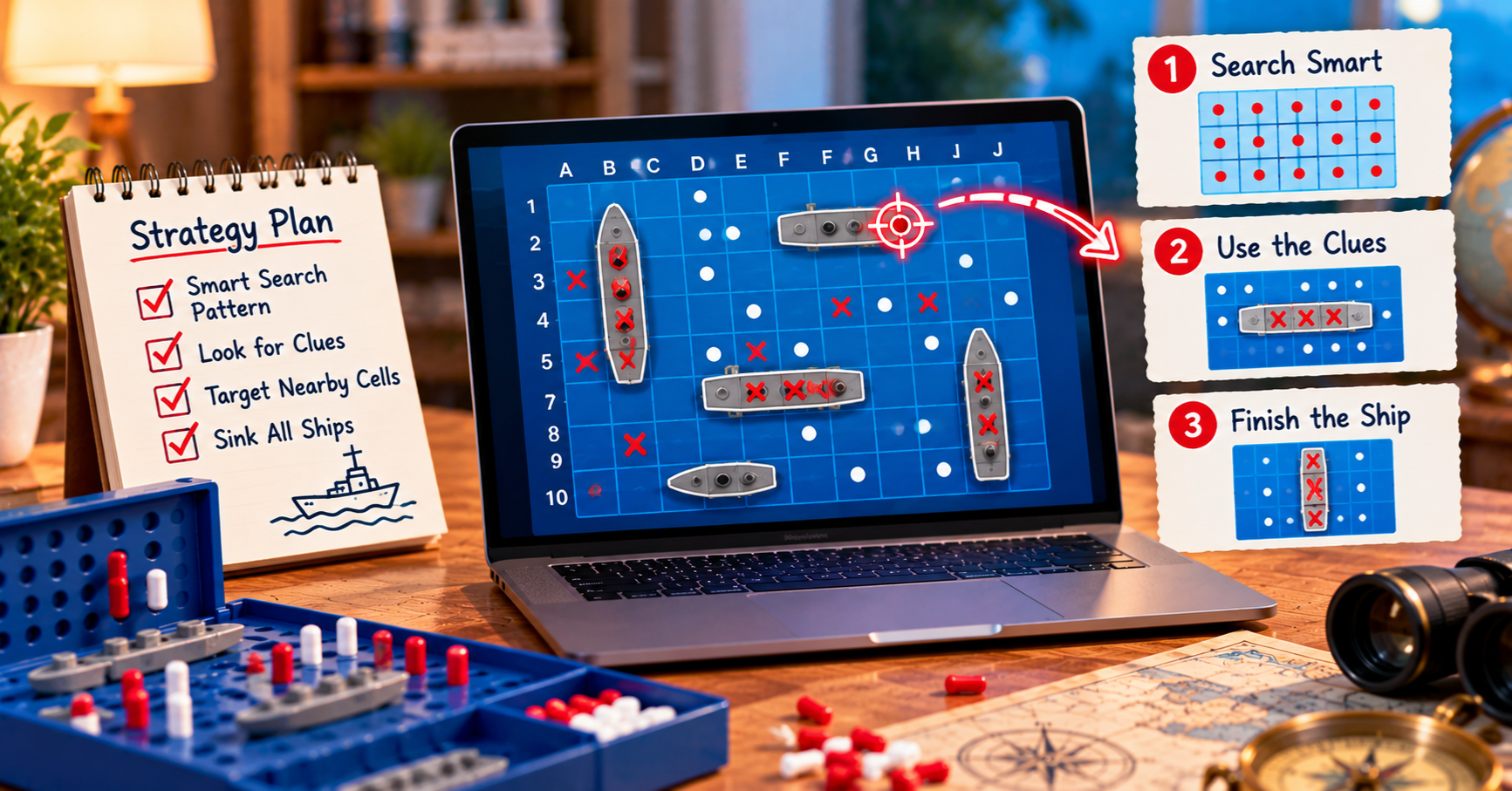
At the start, many squares are plausible. Spacing your shots can reveal more of the board than firing repeatedly into one empty corner. Some players use a checkerboard pattern while looking for ships of length two or more: any horizontal or vertical ship of that length touches at least one color of a checkerboard. This can reduce wasted search shots under standard placement rules.
The pattern needs adjustment as the game changes. If the version includes a single-square ship, a checkerboard search alone will not guarantee finding it. And once you know which ships remain, a gap too short to hold any of them is usually a poor place to fire. Check the actual fleet and board rules in the Battleship game online before relying on a pattern.
Switch to local search after a hit
A hit makes the neighboring squares more interesting. Test untried squares in the four cardinal directions, not diagonally: a straight ship continues along a row or column. When you get a second hit on the same ship, follow that direction to learn where it ends. If the next square misses, return to the first hit or try the other end.
Be careful about assuming that two nearby hits must belong to one vessel if the rules allow ships to touch. A sunk-ship notification, when available, helps confirm which squares belong together. Use the board's feedback rather than forcing a pattern onto uncertain evidence.
Update your guesses as ships sink
Suppose the smallest remaining ship occupies three squares. A two-square gap enclosed by misses cannot hide that ship horizontally, though it might still intersect another valid placement vertically. Eliminate only positions that truly cannot contain a remaining vessel. The longer the game goes on, the more useful this habit becomes.
It also helps to inspect edges. A ship can sit against an edge if placement rules allow it. Do not rule those squares out simply because the center seems more likely. What matters is how many legal placements still include a square, given the hits, misses, and remaining fleet.
Place your own ships with care
While attacking is the obvious part of the naval battle, deployment affects the match too. Avoid using the same arrangement every time against a familiar opponent. Mix horizontal and vertical placements if the rules allow, and make sure no piece extends outside the grid or violates a no-touch rule if that version uses one.
No setup is guaranteed to survive against a careful searcher. The practical goal is to avoid predictable habits while making legal placements you can remember if you are playing off-screen.
When you play Battleship on Entertainment Couch, try one round with a deliberate search pattern. After the first hit, switch to testing the nearby straight-line possibilities. Your choices may still depend on uncertainty, but each shot should narrow it.